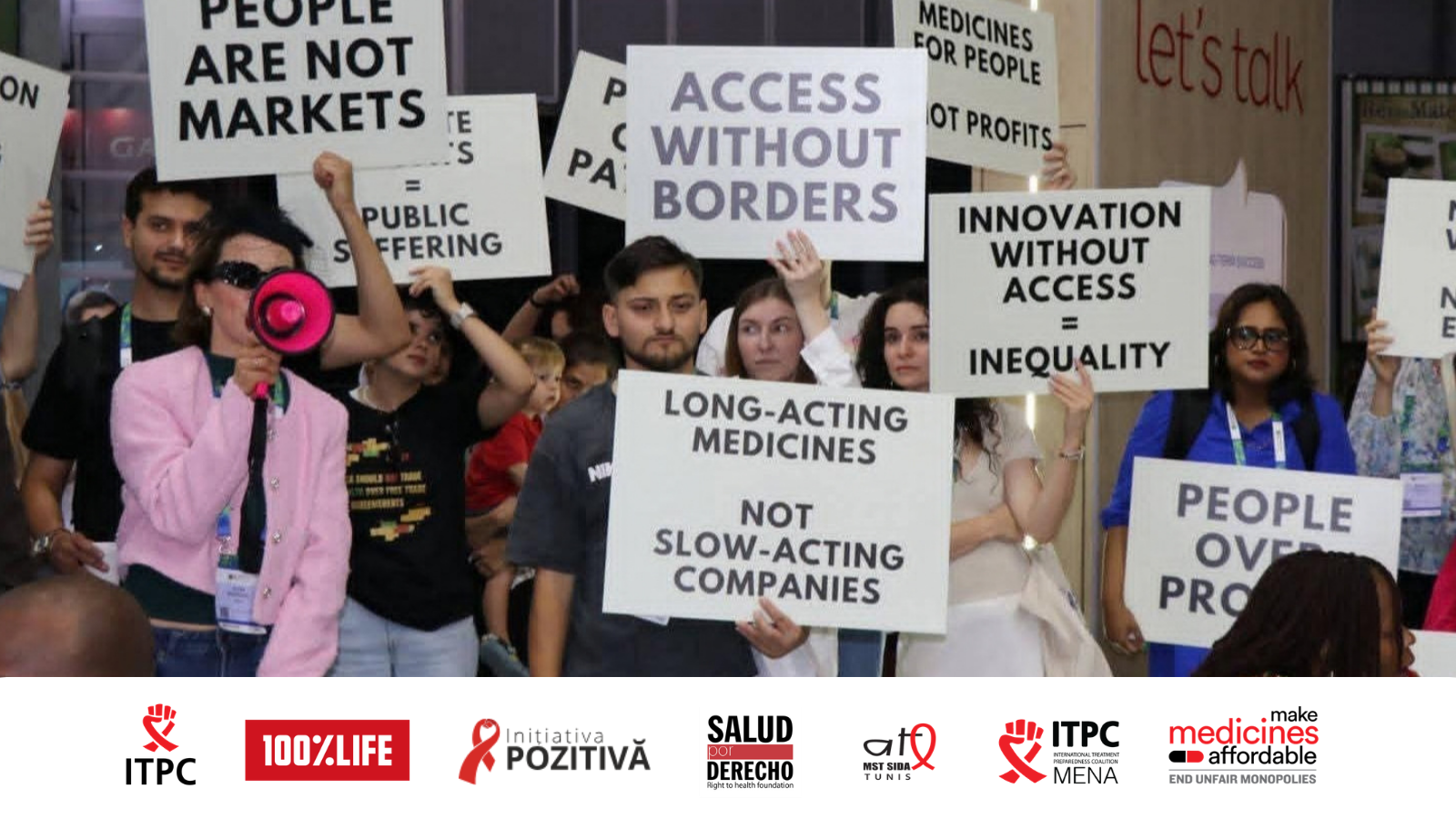
On 23 September 2026, 100% Life (Ukraine), Initiativa Pozitivă/Positive Initiative (Moldova), the International Treatment Preparedness Coalition – Middle East and North Africa (ITPC MENA, Morocco), ATL MST-SIDA (Tunisia), and Salud por Derecho (Spain) have jointly filed a third-party observation with the European Patent Office (EPO) opposing a patent application filed by Merck Sharp & Dohme LLC (“Merck”) that claims prodrug forms of alimatravir (MK-8527), Merck’s investigational once-monthly oral pill for HIV pre-exposure prophylaxis (PrEP), currently in Phase 3 clinical trials.
In accordance with Article 115 of the European Patent Convention (EPC), following the publication of a European patent application, any third party may, in proceedings before the EPO, present observations concerning the patentability of the claimed invention to which the application relates. The coalition’s observation targets European patent application no. EP 24709908.8 (publication no. EP 4658663 А2), titled “Prodrugs of 4’-substituted nucleoside reverse transcriptase inhibitors” filed by Merck on 26 January 2024. The application does not claim alimatravir itself — already known, publicly disclosed technology — but prodrug derivatives of it, which the coalition argues fails the EPC’s patentability requirements and reflects a strategy of evergreening. As the present European patent application was filed with requests for validation in Moldova, Morocco and Tunisia, the grant and subsequent validation of a European patent on this application will result in enforceable patent rights in EU countries, as well as in Moldova, Morocco and Tunisia, delaying generic market entry and restricting access to affordable alimatravir.
“Merck is trying to extend its monopoly through a prodrug patent that adds nothing genuinely inventive to the compound (MK-8527) it has already disclosed. In particular, the claimed invention does not involve an inventive step over the prior art, and the application fails to meet the requirements of clarity and sufficiency of disclosure. Granting such patent at the EPO would create an additional patent barrier without corresponding inventive contribution, with its effects extending to countries such as Moldova, Morocco and Tunisia through the system for validating European patents”, said Veronika Kochubei, Intellectual Property Counsel at 100% Life (Ukraine).
“Moldova is not part of Merck’s voluntary licence. If this patent is validated here, communities most affected by HIV will have very limited access to branded product, which will probably be highly priced”, said Alina Cojocari, Head of the Department for People Living with HIV of Initiativa Pozitivă / Positive Initiative (Moldova).
“Morocco never examines this patent, it simply inherits whatever the EPO grants, through the validation agreement, and Moroccan law gives us no administrative pre-grant or post-grant opposition once a patent is granted. We have also tested patent invalidation through the courts, and it does not work to balance intellectual property rights with the public interest. This observation is the only moment Moroccan communities get a say. We call on the EPO to reject the patent application”, said Othmane Marrakchi, Advocacy Lead at ITPC MENA.
“Tunisia is a validation state, and our health system cannot afford the potentially high price of originator alimatravir that could be produced for just a few dollars a year”, said Kods Brahmi of ATL MST-SIDA (Tunisia).
“Voluntary licences that the company can withdraw the moment its patents are challenged by generic manufacturer-licensee cannot substitute for ensuring that patents lacking genuine inventive merit are not granted in the first place”, said Vanessa López, Executive Director of Salud por Derecho (Spain).
Context
Alimatravir (MK-8527) is Merck’s investigational, once-monthly oral HIV PrEP pill, a nucleoside reverse transcriptase translocation inhibitor (NRTTI) in Phase 3 development. In July 2026, Merck announced royalty-free voluntary licences for seven generic manufacturers covering 129 low- and middle-income countries, but has not disclosed a price (1).
Independent cost-of-production analysis presented at the 26th International AIDS Conference (AIDS 2026) estimated that the product could be manufactured and sold profitably for around US$3 per person per year . As examples, LEN can be produced for an estimated $25-46 per person, per year (PPPY), yet it is priced at ~$28,218/year in the US. CAB-LA costs an estimated $15-23 PPPY to produce vs. the US price of ~$25,374 PPPY– over 1,100-fold higher. Merck’s published text of the voluntary licence agreement also allows the company to terminate the licence immediately if a generic manufacturer challenges the validity of its patents and bars sales outside the licensed territory, meaning that patent barriers, rather than licensing arrangements, remain decisive for access in countries such as Moldova, which fall outside the announced licensing territory (2).
(1) Merck, “Merck Announces Initial Access Plans for Alimatravir, an Investigational Once-Monthly Oral HIV Pre-Exposure Prophylaxis in Phase 3 Development,” 23 July 2026, https://www.merck.com/news/merck-announces-initial-access-plans-for-alimatravir-an-investigational-once-monthly-oral-hiv-pre-exposure-prophylaxis-in-phase-3-development/
(2) Make Medicines Affordable, “Alimatravir Should Cost $3 a Year: A Voluntary License Won’t Get Us There” 2026. https://makemedicinesaffordable.org/alimatravir-should-cost-3-a-year-a-voluntary-license-wont-get-us-there/





 info@network.org.ua
  +38 (044) 339-93-50
  87A, Mezhyhirska St., Kyiv